Softhouse

All about AI

All About AI: From Code to Impact

Welcome to our knowledge hub on artificial intelligence. Here we gather articles, guides, and insights that explore AI from multiple perspectives. We believe in understanding the technology in depth, but also in daring to ask what it means for us, our organizations, and our future. All About AI is for those who want to understand, apply, and challenge AI.

What Is Artificial Intelligence (AI)?

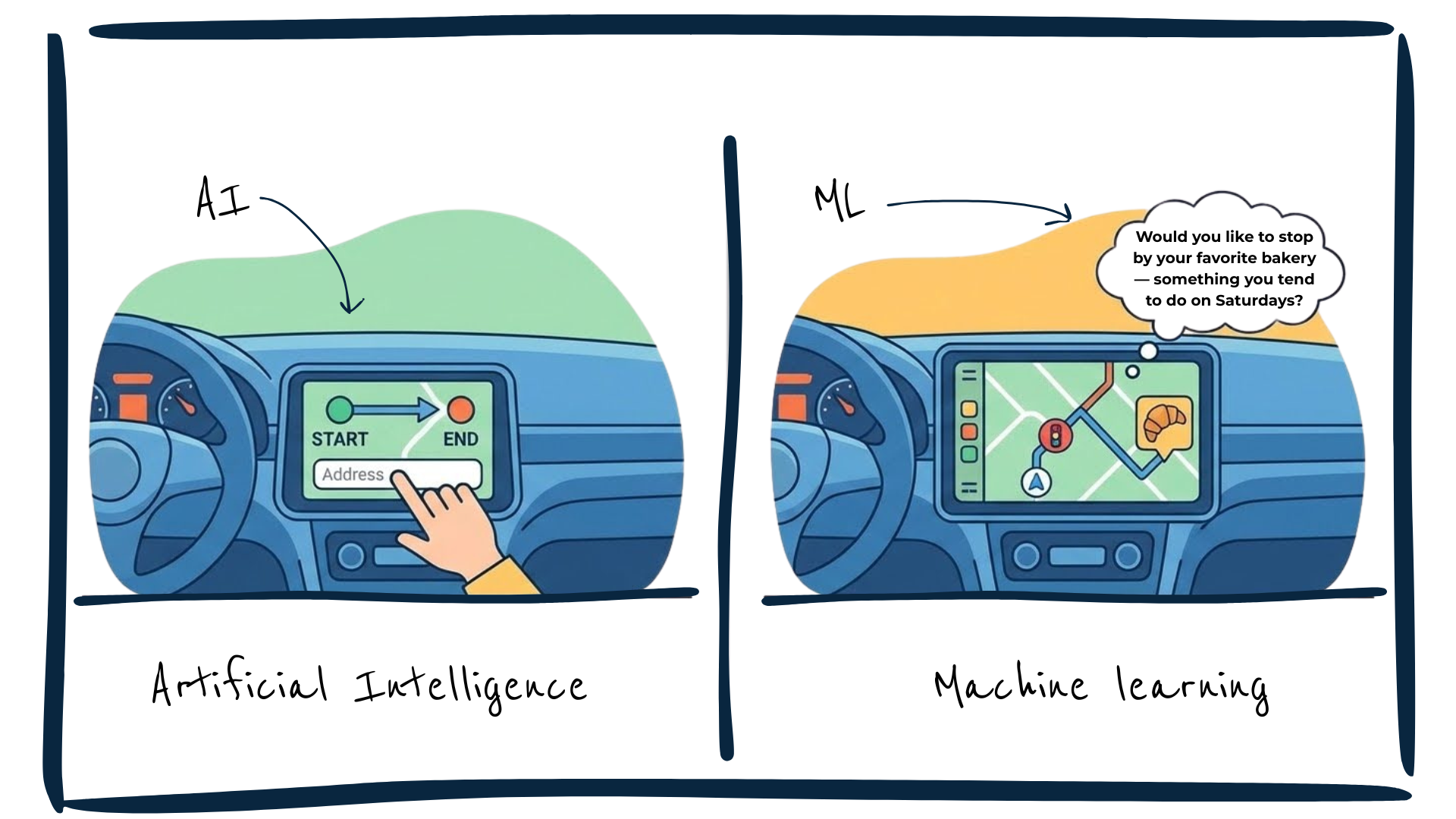
Artificial intelligence is an umbrella term for technologies that enable systems to analyze data, learn from experience, and make decisions without being explicitly programmed for every scenario. Unlike traditional software, AI systems can:

  • Identify patterns in large datasets
  • Improve over time
  • Provide predictions and recommendations
  • Automate complex decision-making

Simply put, AI helps us understand more and helps you make better decisions. If you want to go deeper into how the technology works behind the scenes, explore our guide on machine learning, where we explain the fundamentals step by step and talk a bit about how models are trained and evaluated. If you are more interested in general knowledge about AI, then our guide “AI in 5 minutes” is something for you.

How Does AI Work in Practice?

In practice, AI relies on three core components: Data, Algorithms, A clear purpose

Without relevant data, nothing happens. Without a clear problem to solve, the solution becomes unclear. In our article on programming languages for AI, we explore the technical choices that influence performance, scalability, and long-term maintainability. We also talk about why getting the architecture right from the start truly matters.

Why Is AI Relevant for Businesses Right Now?

Three things have changed dramatically in recent years: The explosion of available data, Affordable and powerful computing resources, Mature tools and platforms

This means AI is no longer experimental. It’s a business tool and should, for example, be used to:

  • Streamline processes
  • Enhance customer experiences
  • Analyze large datasets in real time
  • Build data-driven decision support

But that doesn’t mean everyone should do everything. It means every organization needs to identify the right use cases. In our AI-related articles, we share insights on how companies can move from idea to implementation without getting lost in technical complexity.

AI Strategy – From Experiment to Business Value

AI adoption is not about experimenting with technology. It’s about creating direction. Many organizations test AI in isolated initiatives. Fewer build a structured AI strategy that connects technology with business goals, priorities, and measurable impact. A well-defined AI strategy helps organizations:

  • Identify the right use cases
  • Prioritize initiatives with the highest business value
  • Ensure data readiness and technical foundations
  • Align teams and stakeholders
  • Build a realistic roadmap for implementation

At Softhouse, we approach AI as a combination of strategy, technology, and people. That means evaluating organizational readiness, data maturity, architecture, and governance. Learn more about our AI and machine learning strategy and how we help organizations move forward with AI, or dive deeper into the ethical risks of AI.

Real-World Examples of AI in Action

AI is already embedded in many organizations and often without being visible to end users. Below are a few common use cases:

  • Predictive analytics and forecasting
  • Workflow automation
  • Risk detection and anomaly analysis
  • Personalization of digital services

In the “Things We’ve Done” section below, you’ll find examples of projects where AI plays a role in delivering tangible results. These cases demonstrate how technology, architecture, and business needs come together in practice.

Common Pitfalls When Investing in AI

We often see recurring patterns in organizations that want to get started with AI. Below, we highlight a few of them without going too deeply into each area:

  1. Starting with technology instead of business needs – AI should solve a real problem — not exist because it sounds modern.
  2. Unclear goals – Without defined outcomes, measuring impact becomes impossible.
  3. Underestimating change management – AI affects workflows, roles, and decision-making processes.
  4. Poor data quality – Low-quality data leads to poor insights. There’s no shortcut around this.

AI Is About More Than Technology

For us, AI is about building solutions that are understandable and usable in everyday operations. It requires more than models and code. It requires thoughtful architecture, secure data handling, and a clear connection to business value. When technology, design, and business understanding come together, that is when AI becomes a tool that truly can make a difference.


Things we have done

  • Officebot – AI That Knows Your Employee Handbook

  • Make Video Searchable and Accessible with AI-Based Transcription

  • Predictive Insights for the Manufacturing Industry

  • AI that understands what you listen to – topic classification for podcasters

  • Smarter Dishwashers for Exceptional Customer Service

  • AI for Smarter Lead Management and Skills Matching

AI in 5 minutes

Read AI in 5 minutes and get hands on tips on how to get started with AI.

NEW English 5 steps - from undigitized to AI-driven [for publishing]

5 steps – How data-mature is your organization?

Download the guide to understand where you stand today and how to move forward with the right focus, structure, and strategy.

Questions about AI

Cloud-based AI solutions provide scalable capacity, flexible tools and faster development. We help you leverage the cloud to implement advanced AI cost-effectively.

We design UI/UX that makes AI and machine learning intuitive and accessible for employees and customers. User-centred design ensures your AI delivers value in practice.

AI Proof of Concept (PoC) is used to test and validate that the core problem is solvable before proceeding with scaling. By focusing on real use cases, we quickly demonstrate measurable impact.

AI prototyping is a quick and effective way to test how AI can create value in your business before full implementation. We build tailored prototypes that show concrete results and insights.

The key is to start with a clear goal and practical use case. We work iteratively with rapid prototyping, testing and validation to deliver measurable value and reduce risk.

We work agilely and collaboratively with our clients – from data collection and modeling to testing, validation, and deployment. Each step builds on insights and continuous delivery to ensure measurable results and fast business impact.

We use MLOps practices to create stable and scalable AI solutions. This includes automated pipelines, testing, versioning, monitoring, and continuous improvement in production environments.

Depending on the project, we either build models from scratch or fine-tune existing models. When fine-tuning existing models we of course ensure license compliance. We always choose the most effective approach for your goals.

We specialize in computer vision, image analysis, natural language processing (NLP), forecasting, anomaly detection, and MLOps. Our teams combine research and engineering to deliver robust solutions with real impact.

Our expert function within AI and machine learning helps companies take their AI initiatives to the next level. We provide advanced model development, data analysis, NLP, and computer vision with a focus on measurable business value and lasting quality.

We support the entire lifecycle — from model development to deployment and operations. After implementation, monitoring, maintenance, retraining, and ongoing performance analysis are essential. With the right processes in place, we ensure your AI solution continues to deliver and adapt over time.
AI and machine learning can be applied across many industries — from manufacturing (quality control) and retail (customer analytics) to healthcare (image analysis), logistics (predictive maintenance), and services (automation and support). Our experience shows that the best results come when the problem is well-defined, data is available, and business value is clear.

We actively address issues such as data protection (GDPR), bias, transparency, and accountability from the earliest stages. By embedding these principles in both use cases and technology, we help you deliver AI solutions that are not only functional but also sustainable and aligned with the right frameworks.

The timeline depends on data maturity, complexity, and how well the AI solution is integrated into your operations. Value-creating prototypes can often be delivered within weeks or a few months. Further iterations and adjustments are usually needed to reach full-scale impact. Having clear KPIs and follow-up plans from the start is key to managing outcomes effectively.

It’s about more than technology: you need strong data quality and organisation, clear goals and priorities, and a solid strategy for integrating AI into your business. Without these components, AI projects risk remaining pilots or isolated initiatives with limited impact.

Yes. Our offer includes consulting on technology platforms (cloud, frameworks, training, and inference environments) and practical model development and deployment. We work with tools such as TensorFlow, PyTorch, and scikit-learn to ensure the technology fits your performance, security, and operational needs.
Our process starts with understanding your business and data sources. Then we identify practical use cases, build a prototype, and test at small scale to measure impact. Once value is proven, we scale up and deploy. This structured approach ensures you achieve real business results rather than just a technical experiment.

Explainable AI means being able to show how and why an AI or machine learning system arrived at a specific decision or result. It builds trust, supports accountability, and is often a regulatory requirement. By working with models and processes that are understandable and transparent, we help you ensure your AI works effectively and can be explained both internally and externally.

Our AI Workshops are interactive sessions where we identify ideas, challenges, and use cases together. The goal is to quickly pinpoint where AI can create the most value in your organization.

An AI Assessment is our structured evaluation of your maturity across strategy, organization, data, technology, and operations. It gives you a clear picture of where you stand and how to move forward with AI.

Create a shared vision, assign ownership, train key roles, and establish a simple operational model (e.g., AI CoE/light). Follow up on results transparently through KPIs.

The cost depends on scope, number of use cases, data assessment, and regulatory context. We recommend a focused approach leading to PoV-ready initiatives.

Typically 4–8 weeks. The timeline depends on data landscape, stakeholders, regulatory requirements, and the need for pre-studies.

Implement privacy-by-design, conduct DPIAs where relevant, use encryption and access controls, and apply human oversight. Define policies for training data and generated outputs.

Match requirements like data volume, security, latency, MLOps, cost, and in-house expertise. Favor open standards and avoid unnecessary vendor lock-in.

Yes. A governance model defines roles, decision forums, policies, and controls for data, model quality, security, ethics, and compliance.

We help you understand what data you already have and what’s missing. By combining business and technical perspectives, we build a strong data foundation that makes AI projects possible.

PoV (Proof of Value) quantifies business impact and KPIs. PoC (Proof of Concept) tests technical feasibility. Together, they minimize risk before scaling.

Balance business value with feasibility — considering data availability, complexity, risk, dependencies, and time-to-value. Start with 1–2 low-risk, high-value PoV projects.

Typically: current state analysis, identification and prioritization of use cases, data maturity assessment, target architecture and platform choice, risk/ethics/GDPR, and a KPI-based roadmap.

The strategy ensures AI initiatives support business goals, have clear priorities and budgets, and that governance, data, and technology are in place for sustainable delivery.

An AI strategy outlines how your organization uses AI to achieve business goals. It includes vision, prioritized use cases, data needs, technology choices, governance, and a realistic roadmap.

upTech our latest episodes

See our previous episodes with Linus Ekenstam och Amer Mohammed.

    Go to Top