Navigating Data Complexity
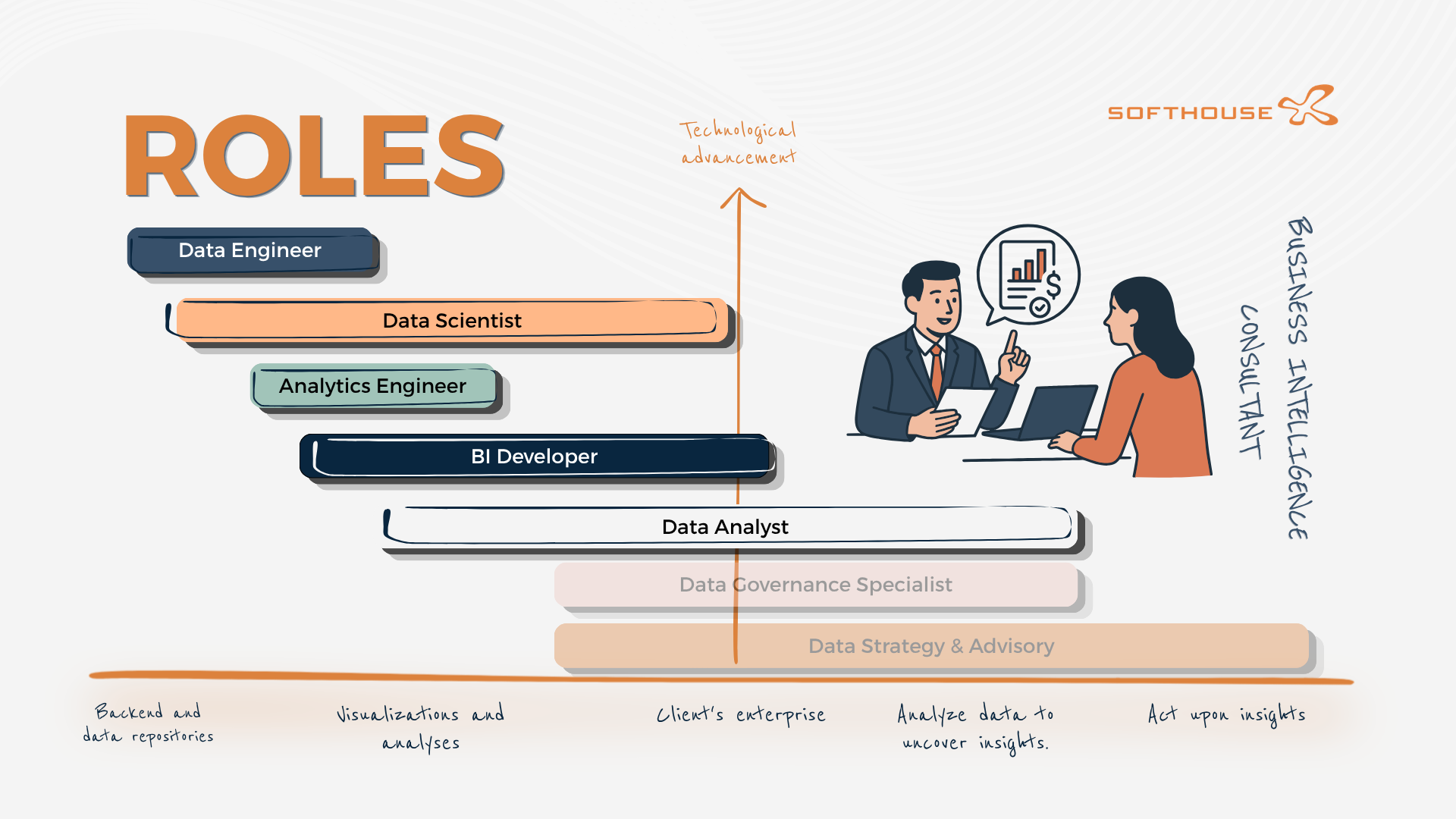
Before an organisation can make data-driven decisions, or even begin talking about becoming AI-native, several steps and roles need to work together. Think of data as flowing through a pipeline, with different people working at different points to ensure that the organisation can benefit from the end result.
The three most common roles involved in the data journey often overlap in terms of responsibilities and skills, which can create confusion. In simplified terms, the data flow can be described as follows:
Step 1: Organise the Data
A Data Engineer is the architect behind the data flow. The role involves designing, building and maintaining pipelines that bring raw data from multiple sources into one place. Here, the data is cleaned, for example: by removing duplicates and applying consistent formatting so that it is ready for analysis and insights.
A Data Engineer ensures that high-quality data is available to the right people.
Step 2: Explain the Data
An Insights Analyst, also known as a Data Analyst, picks up where the Data Engineer leaves off. They use the data to analyse, visualise, report on and explain historical information to business stakeholders, as well as provide them with recommendations.
This is often done through BI tools such as Power BI or Qlik, along with ad hoc analyses. In practice, the role can be divided into three areas of responsibility:
- Analytics Engineer: Builds the analytical structure through which data is consumed, focusing on transforming and modelling the available data within the data warehouse. This may include creating data marts and aggregated tables, establishing consistent naming conventions and defining metrics. The aim is to optimise the data flow specifically for BI tools and rapid analysis.
- BI Developer: Creates dashboards and reports by visualising KPIs (Key Performance Indicators).
- Business Analyst: Works closely with the business to interpret and explain insights and trends, and to communicate recommendations to business stakeholders.
Step 3: Model the Data
A Data Scientist also uses the data made available by a Data Engineer. Unlike a Data Analyst, however, a Data Scientist develops models and AI solutions to generate predictive insights or conduct in-depth classification analyses, such as fraud detection.
Successful Data Teams: When Every Role Works Together
A data flow works well when a complete range of data expertise (from engineering to analysis) works together to enable digital transformation. Combined with strong data governance and a clear data strategy, this enables the organisation to interpret and make sense of its data.
More about Data Analytics
At the very core of our work is our passion for sharing and our constant desire to learn and develop. At Softhouse, we don’t just adapt to tech shifts—we shape them. By testing tools, listening to our developers, and sharing real findings, we’re building a future where AI and human expertise work together, every day. Data can feel overwhelming. It doesn’t have to be. Download our 5 Step guide and let us guide you.
![NEW English 5 steps - from undigitized to AI-driven [for publishing]](https://www.softhouse.se/wp-content/uploads/2026/02/NEW-English-5-steps-from-undigitized-to-AI-driven-for-publishing.png "NEW English 5 steps – from undigitized to AI-driven [for publishing]")