The year was 1995. Mikael Reinholdsson was 27 years old and had just landed his very first job after finishing his studies in Lund. He was hired by Tord Olsson and assigned Staffan Persson as his mentor to learn the craft of software development. But it did not take long before Tord asked the question that would change everything: “Should we start a company?” Together with Staffan, they founded Softhouse. The motivation was simple — they wanted to build a workplace that was more enjoyable, more human, and simply better than the one they came from.
The company was born in the middle of the booming IT era. After just one year, the small team had grown to seven people and generated a profit of one million SEK. To celebrate, they rented a limousine and drove all the way to Skanör for a traditional goose dinner. But the party did not last forever. Not long after, the dot-com crash hit, and reality suddenly looked very different.
A bold decision during difficult times
Thanks to strong and long-term customer relationships with companies such as Ericsson, Softhouse managed to survive the crisis. And it was during this period that one of the company’s most important strategic decisions was made. By daring to expand beyond Malmö and open an office in Karlskrona, Softhouse laid the foundation for the local presence and close customer relationships that still define the company today. For many years, Mikael worked on enormous customer projects, sometimes involving teams of up to 1,500 people. Today, he has stepped away from the largest operational projects to focus more on portfolio companies and board assignments. But his curiosity and excitement for the next major technological shift are stronger than ever.
We adapt, again
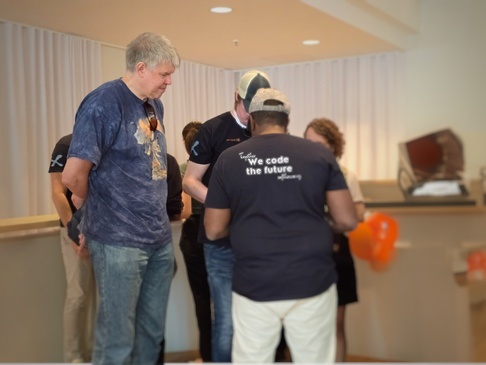 Softhouse has always been quick to adapt. The company was an early adopter of agile ways of working, but today the focus lies on something much bigger: artificial intelligence. Mikael sees AI as one of the most defining forces of the future. In many ways, he has worked with AI throughout different stages of his entire career and even experimented with it during his university years. But according to him, the real revolution happened only recently.
“Everything changed when people figured out how to do it in 2017,” Mikael explains. “That’s when Google released the research paper ‘Attention is everything.’ Every AI model being used today is built on that technology. Nobody has come up with anything better yet — it started everything.”
With that technological shift in mind, the direction forward is crystal clear.
“Looking ahead, we need to carry our agile heritage with us, but we also need to become an AI company to stay relevant,” Mikael says. “The world is changing, and we need to change with it. We are good at adapting and helping customers make use of new technology.”
The people who come back
A lot has changed since 1995. Competition is now global, and technologies come and go. But regardless of whether Softhouse is building solutions in Java or AI, Mikael believes the real strength has always been the culture. He proudly points out that Softhouse has many “returners” — former employees who leave to try something new, only to later come back. By creating a culture where people genuinely care for one another, and where there are no hard feelings when someone wants to explore new opportunities, Softhouse has become a place people want to return to. And to Mikael, that may be the clearest proof of all that the dream of building a better workplace actually became reality.
Monster trucks and two flags on an Icelandic glacier
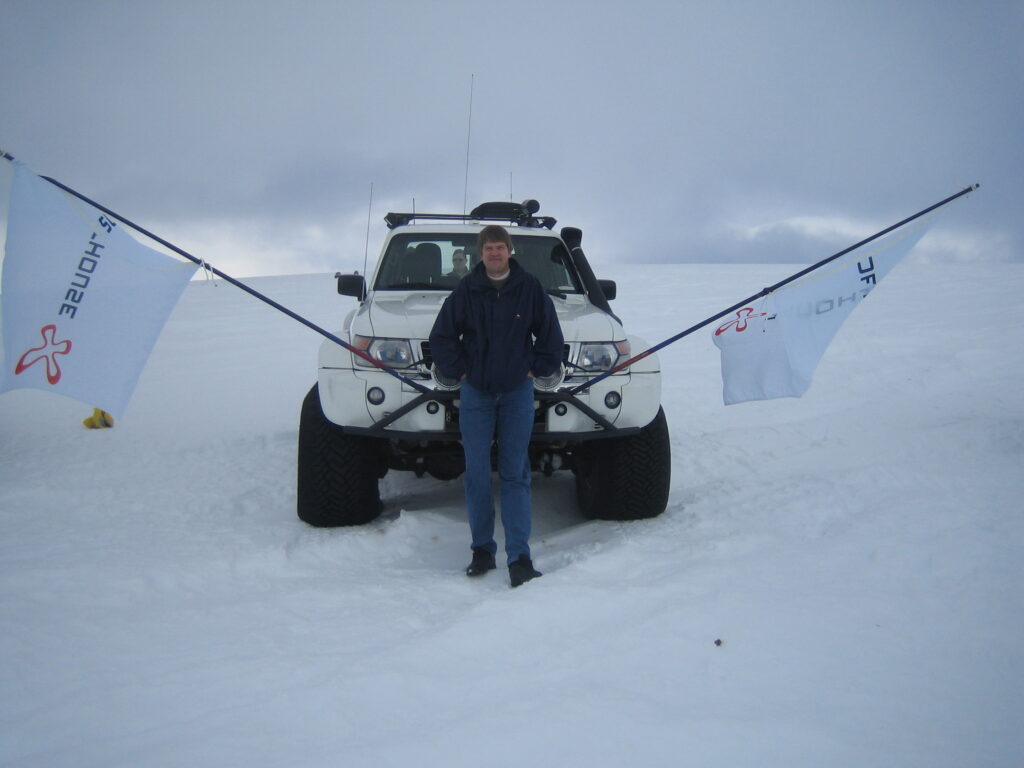
Over the years, the company has created countless unforgettable memories together. But when Mikael is asked which old memory stands out the most, he does not hesitate for a second. The answer is a wildly memorable conference trip to Iceland. Instead of exploring the island by ordinary tourist bus, the group decided on a slightly more unconventional approach.
“We invited a guy who was the Icelandic rally champion. Together with his brothers and cousins, we drove around the entire island in gigantic monster trucks and somehow managed to see all of Iceland in a single day,” Mikael laughs.
With crackling radio communication between the massive jeeps, the trip quickly turned into a full-scale adventure.
“First, we drove to a waterfall, then past Snorri Sturluson’s old cabin, before racing all the way up onto a glacier. We had lunch there and planted a Softhouse flag at the top. On the way down, we looked into the crater of a volcano, stopped by the geysers, and then drove back at full speed,” he remembers.
It is a memory that captures the Softhouse culture remarkably well: the courage to do things differently, the importance of building strong teams, and the belief that the journey should be genuinely fun along the way.